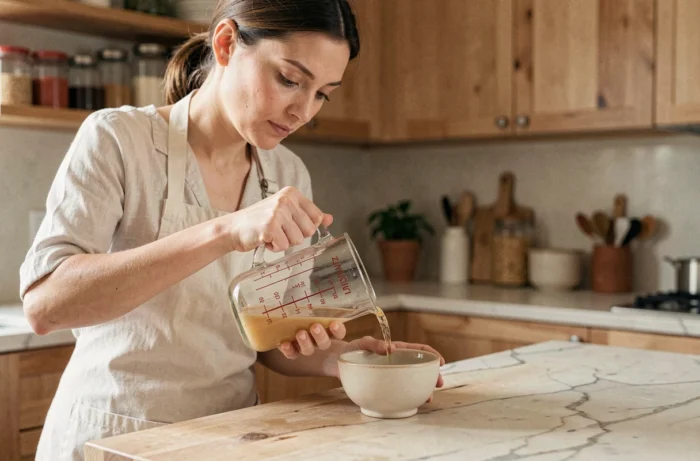
You open a cookbook, and the ingredient list calls for 250 ml of milk. Your measuring jug, however, is marked in centilitres. This mismatch between ml and cl comes up with every recipe, but the good news is that you can sort it out with one simple calculation.
Why ml and cl both appear on your kitchen utensils
Millilitres and centilitres both measure liquid volume. A millilitre is one-thousandth of a litre, while a centilitre is one-hundredth of a litre. Both units belong to the metric system and are used everywhere: milk cartons marked in ml, measuring jugs marked in cl, and recipes that mix the two.
The problem isn’t the conversion itself, which is very simple. It’s that kitchenware manufacturers and recipe writers don’t agree on a single unit. French cookbooks often use centilitres, while recipes found online may favour millilitres.
To convert 250 ml to cl, simply divide by 10. The result is immediate: 250 ml is exactly 25 cl. This rule works for any volume, whatever the liquid.
How to convert ml to cl, step by step
Here’s the rule in its simplest form. One centilitre contains 10 millilitres. To convert ml to cl, divide by 10. To do the reverse (cl to ml), multiply by 10.
A practical example with 250 ml
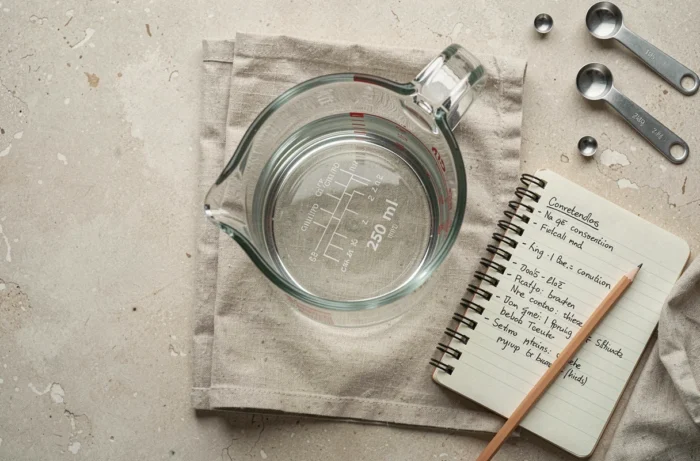
Your recipe calls for 250 ml of water. Divide 250 by 10, and you get 25 cl. Pour the liquid up to the 25 cl mark on your measuring jug, and you’re all set.
Using the same method, you can quickly convert other common volumes:
- 100 ml of single cream becomes 10 cl (100 divided by 10)
- 150 ml of milk becomes 15 cl
- 500 ml of stock becomes 50 cl, or half a litre
- 75 ml of coffee becomes 7.5 cl
Dividing by 10 is the same as moving the decimal point one place to the left. If you see 75 ml, mentally place the decimal point before the 5: 7.5 cl. No calculator needed.
Volume and weight: the confusion that throws off measurements
You may have heard that one millilitre of water weighs one gram. That’s true for pure water at room temperature. This equivalence doesn’t apply to all liquids.
Milk, for example, is slightly denser than water. Oil, on the other hand, is lighter. Honey is considerably heavier. If a recipe calls for 250 ml of honey and you put the jar on a scale aiming for 250 g, you’ll use too little.
When a scale is a handy substitute—and when it can mislead
For water, the relationship between ml and grams is reliable: 250 ml of water weighs about 250 g. If you can’t find your measuring jug, a scale will do the job.
For oil, milk, or any other liquid with a different density from water, using a scale can lead to inaccurate measurements. Always use a measuring jug marked in ml or cl when a recipe gives a volume.

Measuring accurately: the small detail that makes all the difference
Knowing the right conversion isn’t enough if you don’t read the measuring jug accurately. A difference of a few millilitres may go unnoticed in a soup, but it can ruin pancake batter or an emulsified sauce.
Place your graduated container on a flat surface. Crouch down so your eyes are level with the liquid. Read the volume at the bottom of the curve formed by the liquid, not at the top edge. This curve, called the meniscus, looks slightly different when viewed from above rather than at eye level.
Using teaspoons and tablespoons as guides
For very small volumes, a measuring jug isn’t precise enough. Recipes then use teaspoons or tablespoons as units of measurement.
- A level teaspoon holds about 5 ml, or 0.5 cl
- A level tablespoon holds about 15 ml, or 1.5 cl
- Three level tablespoons give about 45 ml, or 4.5 cl
These measurements are useful for small amounts of vanilla extract, lemon juice, or oil. For anything over 50 ml, a measuring jug is more reliable.
Cups, mugs, and international recipes: watch out for pitfalls
A metric cup holds 250 ml, or 25 cl. When a French recipe calls for “one cup,” this is generally the amount it means.
Anglo-Saxon recipes, however, sometimes use different conventions. Always check where the recipe comes from before filling a mug at random. A standard kitchen mug doesn’t necessarily hold 250 ml; its capacity varies from one model to another.
The safest approach is to use a graduated measuring jug rather than relying on the size of an everyday container. This small extra step prevents unpleasant surprises, especially in baking, where liquid proportions directly affect the final texture.
Converting between ml and cl takes just one calculation: divide by 10 to go from millilitres to centilitres, and multiply by 10 to go the other way. For 250 ml, the answer is always 25 cl, whether you’re measuring water, milk, or stock. Keep a measuring jug close at hand, read it at eye level, and you’ll get the measurements right every time.