
Polo Club and Ralph Lauren share a common visual universe, that of polo and the embroidered rider. This graphic proximity blurs the reading of labels, especially on online sales platforms where both brands appear side by side. Comparing their positioning, brand architecture, and price levels allows us to measure what truly separates them.
Comparison Table: Polo Club vs. Polo Ralph Lauren
| Criterion | Polo Club | Polo Ralph Lauren |
|---|---|---|
| Owner | Independent brand, not linked to Ralph Lauren Corporation | Sub-brand of Ralph Lauren Corporation |
| Logo | Embroidered rider, often visually similar | Rider with mallet, historic trademark |
| Price Positioning | Entry-level to mid-range | Mid-range to premium |
| Distribution Network | Mainly online and through multi-brand platforms | Owned stores, department stores, official website |
| Product Range | Polos, shirts, basic accessories | Complete collections (ready-to-wear, fragrances, home, accessories) |
This table lays the groundwork. The confusion lies in a similar name and logo, but Polo Club does not belong to Ralph Lauren Corporation. This point deserves clarification before any purchase.
To better understand the difference between Polo Club and Ralph Lauren, one must understand how each brand builds its identity.

Ralph Lauren Brand Architecture: Why “Polo” is a Sub-Brand
Ralph Lauren Corporation is not limited to a single logo. The company has built a portfolio of hierarchical sub-brands. “Polo Ralph Lauren” refers to the most identifiable line, that of the rider with the mallet, conceived as the mainstream heart of the offering.
Above it are the Ralph Lauren Collection and Purple Label lines, reserved for the luxury segment. Below, Lauren Ralph Lauren targets a broader audience, particularly through retailers like Macy’s in the United States. Polo Ralph Lauren occupies the middle of this pyramid, between accessibility and premium image.
This segmentation explains why the word “Polo” alone is not enough to identify a Ralph Lauren product. The parent brand actively protects this territory. The legal battle between Ralph Lauren Corporation and the United States Polo Association is the most visible proof: the two entities coexist in the same visual universe of polo, but their owners, histories, and positioning have nothing in common.
A Long-Standing Legal Dispute
The dispute between Polo Ralph Lauren and U.S. Polo Assn. has led to several documented proceedings. The United States Polo Association, the organization federating American polo, markets its own clothing under the U.S. Polo Assn. brand. The two embroidered riders look similar enough to create lasting confusion among consumers.
Polo Club, with no direct link to this association either, is part of the same phenomenon. Several brands exploit the imagery of polo without belonging to the Ralph Lauren group, which adds to the confusion in stores and online.
Labels and Logo: The Details That Distinguish the Two Brands
On a hanger, two polos embroidered with a rider may seem identical. However, the differences can be spotted in a few specific places.
- The Polo Ralph Lauren rider holds a raised mallet, with specific typography under the logo. The collar label always mentions “Polo by Ralph Lauren” or “Polo Ralph Lauren”.
- The Polo Club rider adopts a sometimes similar posture, but the inner label never bears the mention “Ralph Lauren”. The full name is generally “Polo Club” followed by a complement (Royal Berkshire, Santa Barbara, etc.).
- The care and composition labels also differ: Ralph Lauren uses a standardized format with a style number and clearly indicated country of manufacture, while Polo Club presents simpler labels.
Checking the collar label remains the most reliable reflex. The logo alone, seen from a distance, is not enough to decide.
Price Positioning and Quality Perception
Polo Club positions itself at significantly lower prices than Polo Ralph Lauren. A basic Polo Club polo costs noticeably less than its Ralph Lauren-branded equivalent. This price gap reflects different manufacturing, distribution, and marketing choices.
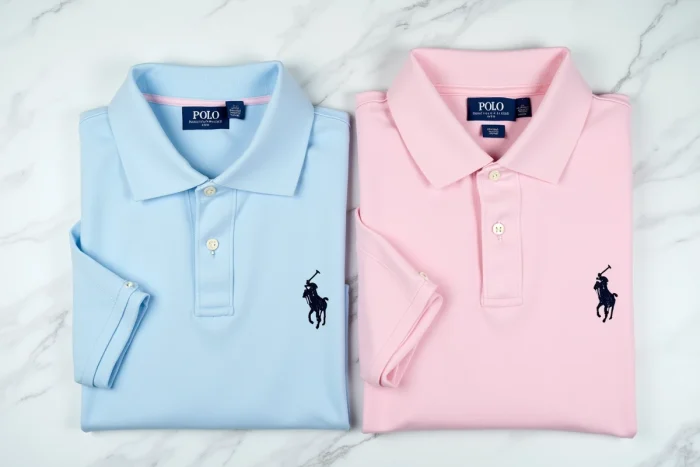
Ralph Lauren invests in owned stores, regular fashion collaborations, and a brand image associated with high-end American lifestyle. Polo Club, on the other hand, relies on online distribution and multi-brand platforms, with more discreet marketing campaigns.
What the Price Concretely Reflects
The fabric, finishes, and cut justify part of the price gap. Polo Ralph Lauren collections use materials with generally superior weight and wash retention. The seams, buttons, and interior finishes exhibit a higher level of detail.
Polo Club offers decent pieces for everyday use, but long-term durability does not match the same level. The quality-price ratio remains its main argument, especially for buyers seeking polo style without the Ralph Lauren budget.
The distinction between these two brands is therefore not just a simple logo detail. Polo Club and Polo Ralph Lauren target different market segments, with promises of quality, durability, and image that do not overlap. Before a purchase, turning the garment inside out and reading the full label remains the safest gesture to know what one is really buying.