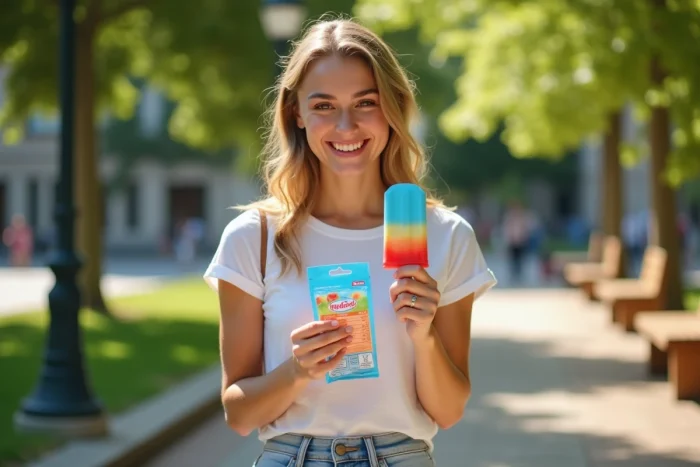
An ice pop sold for a few cents, consumed in less than two minutes and perceived as harmless: Mister Freeze holds a special place in summer habits. Its reputation as a light product is based on a modest caloric intake compared to traditional ice creams. The actual composition of these colorful tubes deserves a closer look than just the simple number displayed on the packaging.
What the ingredient list reveals beyond calories
The common reflex is to look at the energy value per unit. A standard Mister Freeze shows a low caloric intake, which is enough to mentally classify it as a reasonable snack. The problem lies elsewhere: almost all of the energy comes from sugars.
A popsicle contains water, sugar or glucose-fructose syrup, flavors, and colorings. Proteins and fats are virtually absent. In other words, the product does not nourish: it provides a quick sugar spike without significant nutritional value.
The debate surrounding Mister Freeze calories in detail benefits from incorporating this often-ignored data: a food can be low in calories while being nutritionally poor. Low caloric density says nothing about the quality of what we consume.
Added sugars and regulation: tightening control
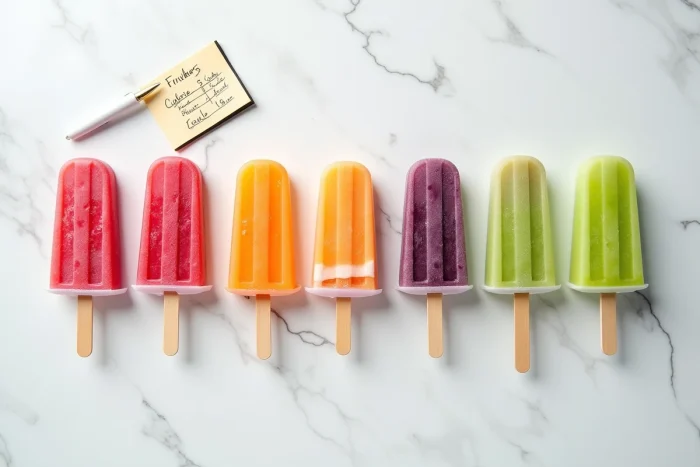
Several store brands (Carrefour Classic, Intermarché Monique Ranou) offer their own water ice pops. Since 2023-2024, these brands have modified their recipes to replace certain artificial colorings with plant-based colorings (spirulina, black carrot, paprika), in a “clean label” approach visible on the Open Food Facts and Yuka product sheets.
This cosmetic transition does not change the sugar content. And on this point, European regulation seriously limits marketing claims. The revision of the guidelines related to Regulation (EC) No. 1924/2006, commented on by the DGCCRF in 2023, specifies that a product can only claim the label “no added sugars” if no sugar, glucose-fructose syrup, fruit juice concentrate used as a sweetener, or honey is added.
Direct consequence: a classic Mister Freeze, whose recipe is based on glucose-fructose syrup, cannot legally present itself as “light” or “no added sugars.” The marketing positioning of the light product thus relies solely on the low caloric value per unit, not on any dietary virtue.
Mister Freeze calories compared to other frozen desserts
The most common comparison pits water ice against ice creams. The caloric difference is real and comes down to a simple factor: ice creams contain fats and dairy proteins, two elements absent from water pops.
A cone of cream ice or a chocolate-covered ice cream bar provides significantly more calories than a Mister Freeze. A fruit sorbet is closer to the ice pop in terms of energy value but generally contains a higher proportion of fruits, thus additional fibers and micronutrients.
The table below summarizes the main categories of frozen desserts according to their profile:
| Type of frozen dessert | Relative caloric intake | Fats | Sugars |
|---|---|---|---|
| Mister Freeze / water ice | Low | Almost none | High (proportion) |
| Fruit sorbet | Low to moderate | Almost none | Moderate to high |
| Vanilla ice cream | Moderate to high | Present | Moderate |
| Chocolate-covered ice cream bar | High | High | High |
The Mister Freeze comes out on top in the “total calories” line, but this victory masks one of the poorest nutritional profiles in the category.
Consuming Mister Freeze without affecting weight: what really matters
The question of whether Mister Freeze makes you gain weight comes up every summer. The answer depends less on the product itself than on the context of consumption. An isolated popsicle, taken after a balanced meal, has no measurable impact on weight.
The risk arises with repeated consumption. Three or four tubes in an afternoon is a cumulative dose of quick sugars that is no longer negligible, especially since the absence of proteins and fibers does not provide any satiety. The tube is consumed quickly, does not fill you up, and invites you to have another.
Some concrete guidelines to maintain enjoyment without imbalance:
- Limit consumption to one or two popsicles per day instead of emptying an entire bag, which reduces the intake of quick sugars throughout the day
- Prefer a homemade ice made from water and blended fruits (strawberry, mango, lemon) to achieve a similar result with added fibers and vitamins
- Do not consider a Mister Freeze as a substitute for fruit or a complete dessert: it is a sweet treat, not a nutritional contribution
The homemade version surpasses the Mister Freeze on all nutritional criteria while remaining just as low in calories. Ice molds and a blender are all you need.
Plant-based colorings and “clean label”: a limited progress
The shift to plant-based colorings observed among several distributors since 2023 responds to consumer demand echoed by food rating apps. Spirulina for blue, black carrot for purple, paprika for orange: the palette remains vibrant, but the source changes.
This change improves the perception of the product without altering its nutritional profile. Sugars, water, and flavors remain the three pillars of the recipe. A Mister Freeze with plant-based colorings provides exactly the same number of calories and the same amount of sugars as an artificially colored popsicle.
The “clean” label reassures about the absence of certain additives, not about overall nutritional quality. Confusing the two remains a common mistake.
The Mister Freeze retains its place as a low-calorie summer treat, provided it is not attributed with virtues it does not possess. A tube now and then poses no problem. Several a day, every day, turn a harmless snack into a regular source of quick sugars without nutritional compensation.