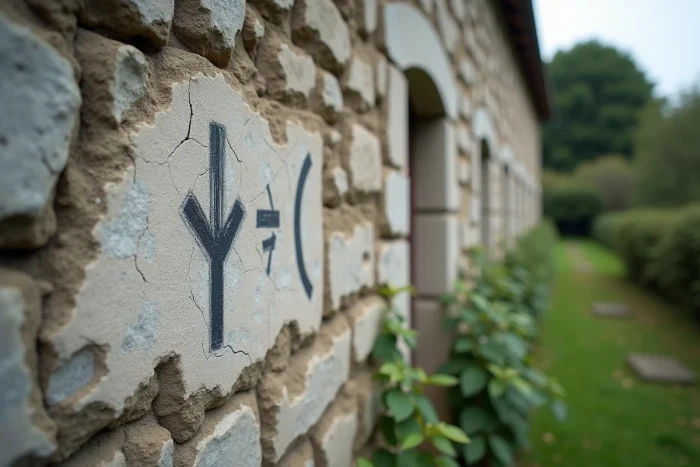
The signs drawn on facades, mailboxes, or sidewalks are often referred to as “gypsy signs.” This popular term encompasses a set of simple graphic marks (circles, crosses, triangles, lines) associated with the scouting of houses before a burglary. Their exact origin remains unclear, and their connection to gypsy or Roma communities is increasingly contested in recent documentation.
Gypsy signs or burglar signs: a misleading term
Common vocabulary associates these markings with gypsy populations. The most recent prevention content is gradually abandoning this wording in favor of neutral terms like “secret marks” or “burglar signs.”
This editorial shift reflects a simple observation: no police source links these symbols to a specific ethnic community. The marks found on homes are used by opportunistic networks, with no demonstrated connection to a particular culture or tradition. Attributing these practices to gypsies is more a stereotype than a documented fact.
Understanding the symbolism of gypsy signs thus requires separating two realities: on one side, the visual codes actually used during criminal scouting, and on the other, the popular beliefs that surround them and give them an almost mystical dimension.
Meaning of the symbols drawn on houses
The marks found on facades convey practical information to potential accomplices. Each symbol condenses information about the dwelling or its occupants.

Symbols related to the occupants
Some marks indicate the perceived vulnerability of the inhabitants. A circle crossed by a cross would signal the presence of an elderly or isolated person. A triangle would indicate that a woman lives alone in the dwelling. These codes target households deemed less likely to resist an intrusion.
Symbols related to the level of protection
Other marks concern the security of the building. A diamond or a crossed rectangle would signal the presence of an alarm system. Conversely, a simple horizontal line would suggest a house without any particular protection device. The absence of marking does not guarantee the absence of scouting, as some burglars prefer to leave no visible trace.
Symbols related to the value of the contents
A square accompanied by a cross or zigzag lines would indicate a dwelling considered financially interesting. These marks often appear near mailboxes or on walls, at eye level.
- Crossed circle: single or elderly person at home
- Triangle: identified single woman in the household
- Square with cross or zigzags: house deemed profitable to burglarize
- Diamond or crossed rectangle: presumed presence of an alarm
- Horizontal line: dwelling without apparent protection
Marking houses: between criminal reality and superstition
Police documentation confirms that marks are sometimes found on burglarized homes. The local police in Montgomery (Belgium) has, for example, published a visual guide to these symbols for citizens.
However, these marks do not alone prove criminal scouting. A chalk line on a wall can have dozens of origins: construction site marking, children’s play, technical marking by a craftsman. The most recent prevention pages emphasize this point and advise against panicking over a simple isolated sign.
The current documentary trend favors a reading based on neighborhood observation rather than on a supposedly universal symbol grid. Scouting relies more on monitoring the habits of the occupants (absence times, closed shutters during the day, accumulated mail) than on a fixed and standardized graphic code.

Symbols of protection and hospitality in gypsy traditions
Beyond the security prism, some symbols associated with gypsy communities belong to a completely different register. In several Romani traditions, marks placed on a home serve to communicate among travelers: signaling a place of welcome, a water source, or conversely, a place to avoid.
These practices of communication among members of a nomadic community have no relation to burglary. They resemble the signs used by American hobos in the early twentieth century, or the trail markers on hiking paths. The amalgamation of these signaling traditions with criminal codes fuels a harmful confusion.
Confusing a sign of hospitality with a mark of criminal scouting reduces an entire culture to a security cliché. The nuance deserves to be clearly stated, especially in a context where online content often reproduces this confusion without questioning it.
What to do if you see a suspicious sign in front of your house
The appropriate reaction to an unusual marking remains pragmatic.
- Photograph the sign before erasing it, to keep an exploitable record
- Quickly clean the mark so that it can no longer serve as a reference
- Report the presence of the symbol to the local police or gendarmerie
- Check the condition of locks, shutters, and any existing security devices
An isolated sign does not justify radically changing your habits. However, multiple marks combined with other indicators (attempted door opening, repeated passage of unknown vehicles) deserve prompt reporting to law enforcement.
The best protection remains collective vigilance among neighbors. A marking that is spotted and erased loses all utility for the one who drew it, regardless of the meaning they attributed to it.