Calculating the area of a room for 30 people seems simple: you multiply a ratio by the number of participants. In reality, the resulting figure can vary significantly depending on the chosen layout, the type of event, and the safety constraints specific to the venue. Common references range from 1 to 2 m² per seated person, but these ranges hide very different realities on the ground.
Acoustics and ceiling height: the forgotten factor in sizing
Most sizing guides reason in square meters of floor space. They overlook a variable that becomes significant once you exceed twenty participants: the total volume of the room and its acoustic treatment.
A 60 m² room with a four-meter ceiling and no sound-absorbing panels generates a reverberation that makes communication difficult after just a few minutes. Conversely, a slightly smaller room but properly treated (wall panels, sound-absorbing ceiling tiles) offers significantly better listening comfort for 30 people.
Acoustic treatment specialists recommend, for medium-sized rooms of 60 to 100 m², a dedicated investment whose cost increases significantly beyond this surface threshold. Before looking for the largest possible room, it is better to check if the venue has undergone minimal acoustic treatment. Asking the site manager avoids many disappointments on the day of the event.
To determine what area for a room of 30 people corresponds to your project, you need to cross-reference the floor area with the ceiling height and the acoustic quality of the venue.
Area per person for 30 participants: what the ratios say and what they conceal
The most common ratio in popular articles hovers around 1.5 m² per seated person. Applied to 30 participants, this results in 45 m². This figure works for a row seating configuration (theater style) without tables, with reduced circulation aisles.
As soon as tables are added, the need increases. In a classroom configuration (tables and chairs facing a screen), you need to account for significantly more. In a U-shape or cluster layout for collaborative workshops, the required area increases further, as each participant occupies a larger space and the passage areas between groups must remain accessible.
The post-Covid evolution of internal requirements
Several insurers and corporate hygiene-safety services now include in their internal specifications a ratio of 2 m² per seated person, excluding circulation and stages. This requirement, absent from public regulations, reflects a change in practice that has emerged in recent years for internal training and seminars.
For 30 people, this ratio raises the usable area to 60 m², to which circulation areas, space for the speaker, and any projection equipment must be added. It’s easy to reach a total of 70 or 80 m². Field feedback varies on this point: some organizers find this ratio excessive for a simple standing cocktail, while others consider it a minimum for a day of training.
Furniture configuration and concrete impact on room area
The furniture is the real area multiplier. Here are the most common configurations for 30 people and their impact on the necessary square meters:
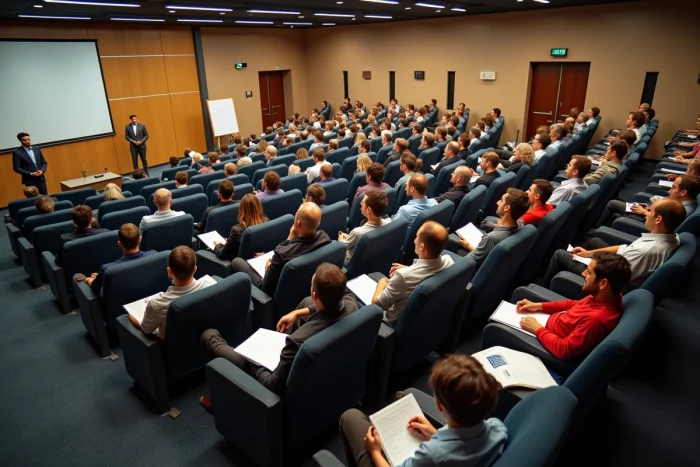
- Theater configuration (chairs in rows, no table): the most compact, suitable for short presentations where participants do not need to take notes on a rigid surface. Usable area around 45 m².
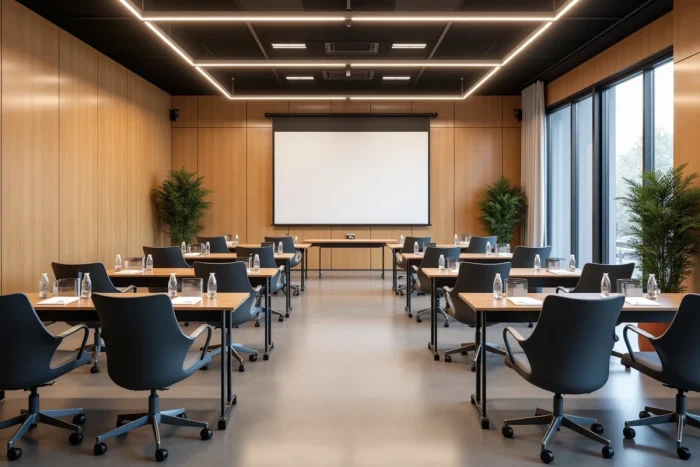
- Classroom configuration (rectangular tables facing the screen): each participant has a workspace. Usable area increases to 60 m² or more depending on the width of the tables and the spacing of the rows.
- U-shape or circle configuration: favored for participatory meetings, it consumes more area as the center of the room remains empty. Plan for at least 70 m² to ensure smooth circulation around the U.
- Cluster configuration (round or square tables for 5 to 6 people): the most space-consuming, as each cluster requires a clearance perimeter. Count on 80 m² or more for 30 participants divided into six groups.
These areas are rough estimates. They do not take into account a potential stage, a buffet at the back of the room, or a reception area at the entrance.
Circulation, accessibility, and safety: the invisible square meters
The aisles of circulation between rows and towards exits are not included in the “per person” ratio, but they represent a significant portion of the total area. The Labor Code and the standards applicable to establishments receiving the public impose minimum clearance widths proportional to the number of occupants.
Accessibility for people with reduced mobility adds an additional constraint. A wheelchair requires a wider passageway than a simple pedestrian aisle, and a dedicated space in the room. Ignoring this dimension when choosing the venue exposes one to refusals of approval or uncomfortable situations on the day of the event.
Ventilation and air renewal
Thirty people in a closed room produce a significant amount of CO2 and heat. A room whose ventilation is not sized for this capacity becomes uncomfortable in less than an hour. Checking the air renewal rate before booking is part of the often-overlooked points, just like acoustics.
Summary table: indicative area according to layout for 30 people
| Configuration | Estimated usable area | Typical use |
|---|---|---|
| Theater (chairs only) | 45 to 55 m² | Presentation, short conference |
| Classroom | 60 to 70 m² | Training, seminar |
| U or circle | 70 to 80 m² | Participatory meeting |
| Clusters | 80 to 100 m² | Collaborative workshops |
| Standing cocktail | 30 to 45 m² | Reception, networking |
These ranges include a minimum of circulation and clearance towards exits. They do not include a stage, buffet area, or reception zone. Each functional addition shifts the necessary area towards the upper end of the range, or even beyond.
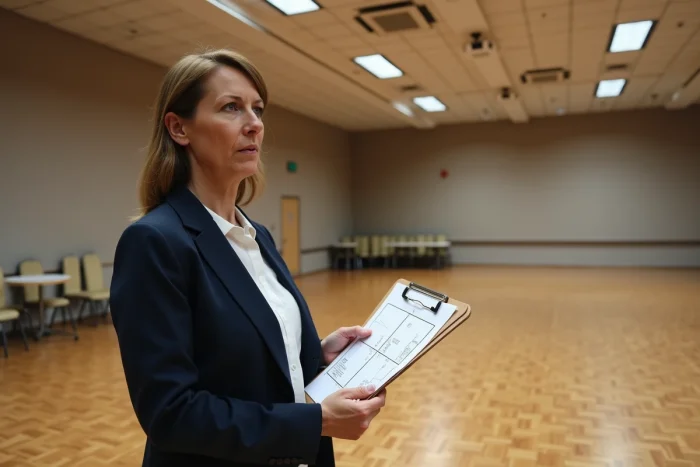
The choice of area for 30 people is not limited to a single ratio. The arrangement of furniture, acoustic treatment, ventilation, and the venue’s specific safety requirements weigh as heavily as the number of participants. Visiting the room in advance, plan in hand, remains the most reliable precaution before any booking.