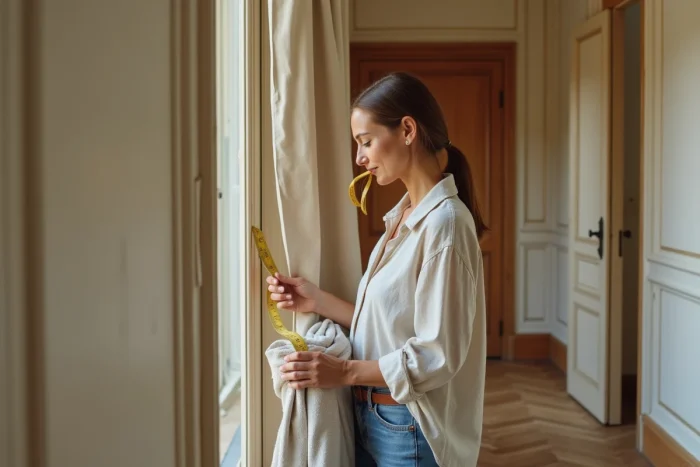
A cool draft that seeps in as soon as you open the front door, a persistent chill in the hallway despite the heating: the entrance door curtain often solves this problem at a modest cost. However, it must be installed correctly. The type of mounting, the length of the fabric, or the choice of the rod make all the difference between a curtain that serves its purpose and a piece of fabric that obstructs passage.
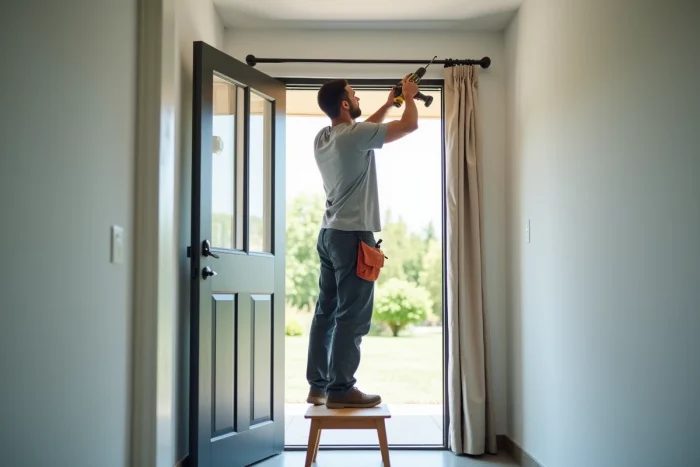
Mounting without drilling: when the classic rod is not an option
Do you live in a rental or is your door frame made of stone? Drilling is not always possible or desirable. Two solutions then exist.
The first is the tension rod (or self-locking rod). It fits between the two uprights by pressure, without screws. It is suitable for openings up to about 120 cm wide. Beyond that, the pressure decreases and the rod may fall under the weight of a heavy curtain.
The second option involves high-quality adhesive supports. They stick directly to the wall or the frame. Before installation, degrease the surface with household alcohol and let it dry. The success of the installation of an entrance door curtain often depends on this preparatory step, which is usually neglected.
With an adhesive support, wait at least 24 hours before hanging the curtain. Hanging the fabric too soon will detach the mounting under its own weight.
Choosing the fabric and weight for an effective door curtain
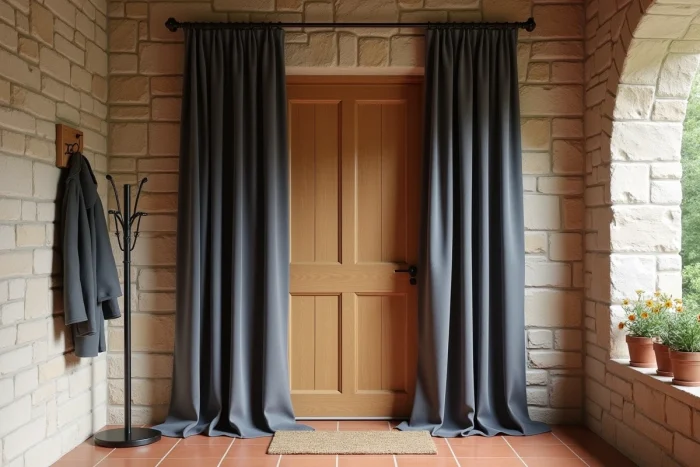
A lightweight sheer will not block the cold or drafts. For a front door, a fabric with a sufficiently dense weight is required, preferably lined. The most commonly used materials are velvet, thick cotton, and thermal lining fabrics.
Why thermal lining makes a difference
The thermal lining is a layer added on the door side, often made of aluminized polyester or fleece. It creates an air pocket between the fabric and the door, which slows down the transmission of cold. Without this lining, even heavy velvet allows some chill to pass through.
Are you hesitating between a ready-to-hang curtain and a custom model? The ready-to-hang works if your door has standard dimensions. For older doors or entrances taller than average, a custom curtain prevents light gaps at the bottom that ruin insulation.
Opacity and light: finding the right compromise
A glazed front door poses a dilemma. A blackout curtain completely blocks light, plunging the hallway into darkness. A sheer lets light through but does not insulate.
The middle ground: an opaque fabric curtain combined with a sheer, mounted on a double rod. The sheer stays in place during the day to filter light, and the thick curtain is drawn in the evening or during cold weather.
Measurements and curtain length: common mistakes
Taking measurements seems simple. However, two mistakes consistently occur.
- Curtain too short that does not touch the floor: cold air passes underneath. Plan for a curtain that reaches one centimeter from the floor, or even brushes the floor if insulation is the priority.
- Curtain too narrow that does not cover the sides of the frame: add at least ten centimeters on each side compared to the width of the opening, so that the fabric also covers the frame.
- Forgetting the door’s opening direction: if the door opens inward, the curtain must be installed far enough back to avoid being caught by the door leaf. A minimum setback of five centimeters above the frame is usually sufficient.
Always measure at three points (top, middle, bottom) for width, and at three points (left, center, right) for height. Walls are almost never perfectly straight, especially in older homes. Keep the largest measurement.
Safety and accessibility: a point often overlooked by decor guides
A thick curtain in front of a front door can pose a security issue. The French Insurance Federation reminds us that any device added to a front door must not obstruct full opening or visibility to the outside. In case of an urgent evacuation, a curtain that is too heavy or poorly fixed slows down exit.
Do you have a relative in a wheelchair or with a walker? Heavily draped curtains that are poorly fixed create an obstacle for people with reduced mobility. In a narrow entrance, opt for a curtain with tiebacks or magnetic fasteners that hold the fabric to the side when the door is open.
- Ensure that the curtain does not block the door handle when closed.
- Choose a side fastening system (tieback, wall hook, magnet) to clear the passage during the day.
- If the curtain is installed in a collective housing or an ERP, consult the PMR accessibility recommendations from Cerema.
A well-installed door curtain improves thermal and acoustic comfort of an entrance without heavy work. The choice of mounting, fabric, and dimensions determines the result as much as the decorative aspect. Take the time to check the opening direction, the actual width of the frame, and compatibility with the daily use of the door. A curtain that obstructs passage ends up folded permanently, which is equivalent to not having one.