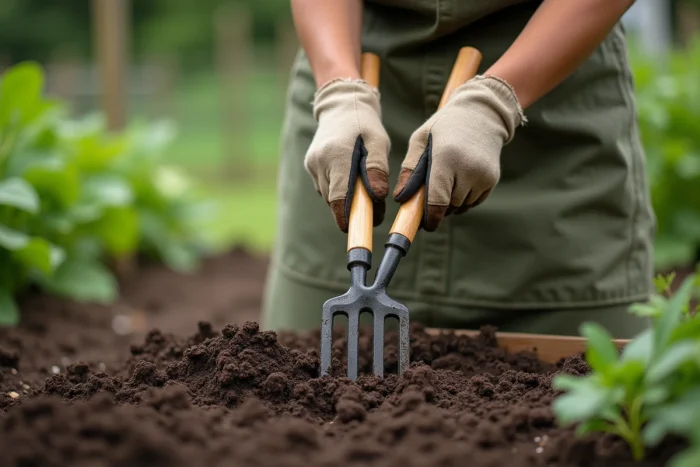
The grelinette aerates the soil without turning it over, which distinguishes it from the spade or the tiller. Measuring the differences between these tools based on specific criteria (impact on soil life, physical effort, versatility) helps to understand why this tool designed by André Grelin is gaining ground in ecological gardening, including in private garden renaturation projects or collective vegetable gardens in companies.
Grelinette, spade, and tiller: comparison based on three gardening criteria
Comparing these three soil working tools based on concrete parameters helps to position the grelinette within a practice of vegetable gardening or ecological gardening.
| Criterion | Grelinette | Classic spade | Tiller |
|---|---|---|---|
| Soil turnover | No (aeration without layer inversion) | Yes (complete inversion) | Yes (fragmentation and mixing) |
| Impact on microbial life and earthworms | Low (stratification preserved) | High (disturbance of horizons) | Very high (mechanical destruction) |
| Back strain | Reduced (lever action, two handles) | High (repetitive turning motion) | Variable (vibrations, weight of the machine) |
| External energy required | None | None | Fuel or electricity |
| Versatility (decompacting, weeding, compost incorporation) | High | Medium | Limited to plowing |
The table highlights a clear gap in the preservation of soil biology. The grelinette maintains the natural stratification of the earth, whereas the spade and tiller destroy it. Ergonomically, the two handles of the grelinette distribute the effort and limit back bending. To explore the available models and their features, resources like grelinette-warrior.com detail the variations based on the number of tines and the quality of the steel.
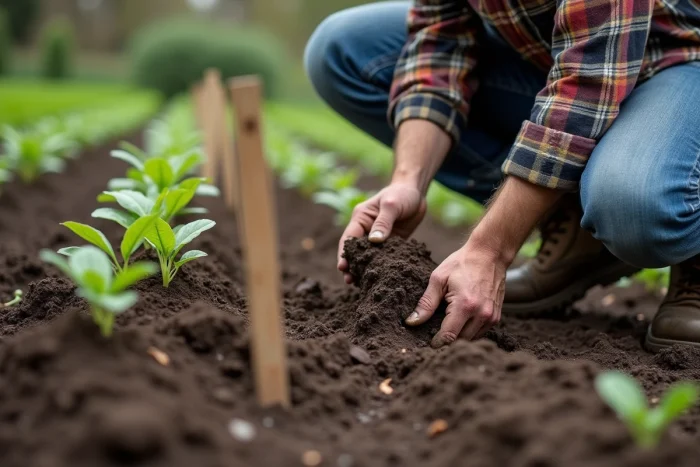
Soil aeration without turnover: what it changes for the vegetable garden
The main argument in favor of the grelinette can be summed up in one sentence: aerate the soil without disturbing the organisms that make it fertile. Earthworms, mycorrhizal fungi, decomposing bacteria occupy specific layers. Inverting these layers, as the spade does, exposes them to conditions (light, drying) that reduce their population.
By pushing the tines of the grelinette into the ground and then tilting the handles backward, the gardener lifts and cracks the soil without turning it over. This movement improves air and water circulation in the soil, two factors that condition root growth of crops.
A direct effect on mulch management
In recent ecological gardening practices, the cycle “autumn mulching, grelinette work after winter, re-mulching” is becoming common. Mulching protects soil life during winter. In spring, a pass with the grelinette is enough to decompact the surface and partially incorporate organic residues. The soil remains covered for most of the year, which limits erosion and the development of weeds.
This cycle works equally well on a vegetable garden bed as on a garden area intended to host native plants or a flowering meadow, in a logic of renaturation.
Grelinette and renaturation projects: an expanding use
The grelinette is no longer confined to the family vegetable garden. In private garden renaturation projects (reintroduction of hedges, creation of microhabitats, sowing of flowering meadows), it is used to locally open the soil without turning it over. The goal is to promote the establishment of plants without disturbing the existing soil fauna.
Collective food gardens in companies, such as the one at CEA in Labège near Toulouse, apply the same principle of gentle aeration. Even if the word “grelinette” does not always appear in these projects, the logic is the same: limit the use of motorized equipment, involve participants in soil work that respects living organisms, and reconcile productivity with the preservation of soil biology.
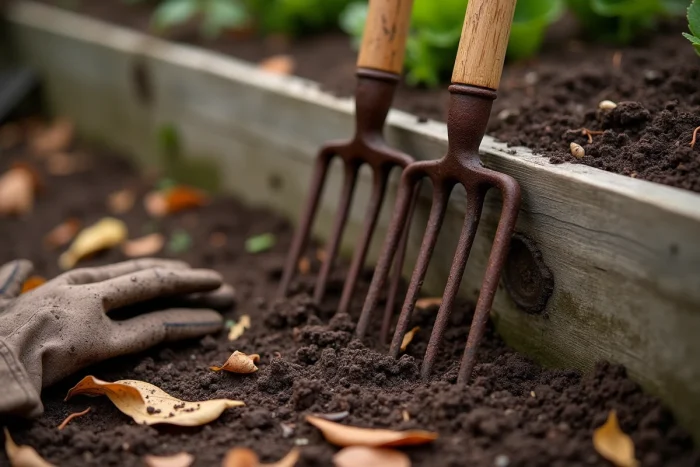
Choosing your grelinette: technical criteria that make a difference
Not all grelinette models are created equal. The choice depends on the nature of the soil, the area to be worked, and the gardener’s morphology. Here are the criteria to consider:
- Number of tines: three-tine models are suitable for heavy, clayey soils, where resistance is high. Five-tine models cover more surface area per pass but require soil that is already relatively loose.
- Quality of the steel of the tines: hardened steel withstands rocks better and retains its sharpness longer. Ordinary steel tines bend in stony soils.
- Length and material of the handles: hardwood handles (ash, beech) absorb vibrations better than metal. The length should be suited to the gardener’s height to avoid bending.
- Working width: it varies according to the number of tines. A width of about 40 to 50 cm per pass is a good compromise between coverage and maneuverability.
A cheap model with thin tines and soft steel will require more effort and wear out quickly. An investment in a quality tool pays off over several seasons of gardening.
Minimal but regular maintenance
After each use, removing the soil stuck to the tines and wiping with an oiled cloth is enough to prevent rust. Storing the grelinette in a dry place prolongs the life of the wooden handles. It is a tool without a motor, without complex wear parts: maintenance is limited to a few minutes per season.
The grelinette remains a tool whose effectiveness depends as much on the technique as on the model chosen. Inserting it vertically, tilting the handles without lifting a clod, stepping forward, and repeating: this simple movement preserves the gardener’s back and the structure of the soil. For an organic vegetable garden, a garden undergoing renaturation, or a collective plot, it advantageously replaces more aggressive tools, provided it is adapted to the nature of the soil being worked.