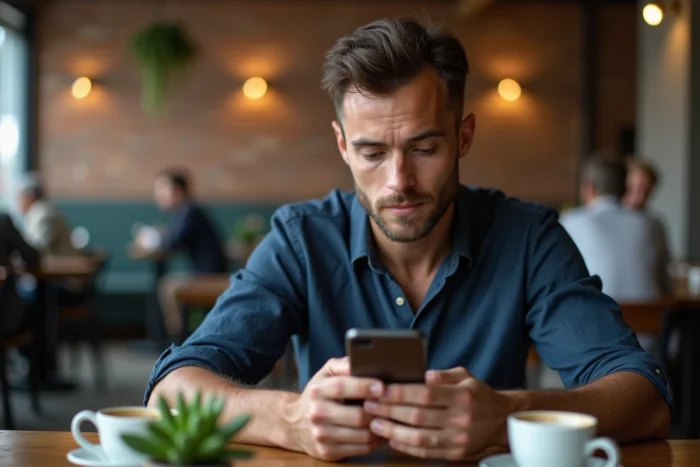
A man opens a gay dating app on the subway, exchanges three sentences, then closes his phone before his seatmate can take a look. This mundane scene encapsulates a tension inherent to gay dialing: the ease of access on one side, the need for discretion on the other. Understanding the strengths and limitations of these platforms before signing up can prevent many disappointments, whether one is looking for light conversation or a more serious relationship.
Geolocation and community filters: what really structures gay dialing
Gay dating apps are often talked about as a homogeneous block. The reality is more fragmented. The market has segmented by subcultures and aesthetic affinities, with specialized platforms (bears, chubs, sporty profiles) coexisting alongside generalists like Grindr or Romeo.
This segmentation has a direct consequence on user experience: profiles are more targeted, but the pool quickly shrinks outside major cities. In Paris or Lyon, it’s easy to find dozens of active profiles within a close radius. In rural areas, geolocation sometimes shows users over an hour away.
Advanced filters (age, body type, interests) are almost always reserved for paid versions. The freemium model dominates: free access to browse profiles, then a subscription to navigate anonymously, see who viewed your profile, or appear at the top of the list. Before committing financially, one can discuss gay dialing on Paris Tribu to gather concrete feedback from users.

Safety on gay apps: useful features and blind spots
The rise in reports of assaults targeting gay men via apps has prompted several platforms to strengthen their protection tools. Grindr, for example, limits mandatory information to the bare minimum and offers fine management options for geolocation. Others integrate reporting and blocking features co-developed with LGBT NGOs.
These measures do not cover everything. Blocking prevents a profile from contacting you again, but does not stop anyone from creating a new account. Anti-harassment filters detect certain keywords in messages, but not more subtle manipulative behaviors.
Verifying a profile before a meeting
Some reflexes can reduce risks without turning every exchange into an investigation:
- Request a quick video exchange before a physical meeting, which allows you to confirm that the person matches their photos.
- Share the location and time of the meeting with a trusted friend, even via a simple text message.
- Prefer a first date in a public and busy place, even if you change the setting later if the chemistry is right.
No app can replace personal vigilance. Feedback varies on this point, but the majority of experienced users recommend never completely disabling geolocation in a context where you do not yet know your interlocutor.
Gay video chat on the web: the discreet alternative to apps
In recent years, video chat rooms accessible directly from a browser have been gaining ground. The principle: chat and flirt without installing a visible app on your phone. For men who do not want an identifiable icon to appear on their home screen, this is a tangible advantage.
These web platforms generally operate without heavy registration. You enter with a nickname, activate your webcam if you wish, and access themed rooms. The downside: the lack of identity verification makes exchanges more random. Moderation depends entirely on each site, and some rooms remain very loosely regulated.
App or website: how to choose
The choice depends on what you are looking for and your personal situation. A dedicated app offers better geographic targeting and more complete profiles. A web chat is better suited for a first exploration without commitment or trace on the phone.
The two formats are not mutually exclusive. Many users combine an app for local dating and a web chat for broader discussions, without the constraint of geographic proximity.

Limitations of gay dialing: fatigue, overexposure, and mismatched expectations
Gay dialing shares with online heterosexual dating a recurring problem: the gap between the volume of contacts and the quality of exchanges. On the most frequented platforms, solicitations are numerous, often reduced to a few words. The repetition eventually generates a form of weariness.
The overexposure of profiles also poses a perception problem. When you see dozens of photos scrolling by each day, you tend to judge more quickly and move on without delving deeper. This mechanism, reinforced by swiping, favors superficial exchanges at the expense of longer conversations.
The freemium model adds a layer of frustration. Free functions are sufficient for browsing, but paid promotion creates a hierarchy of visibility. Free profiles are mechanically seen less, which can give the impression that the platform is not working when you are simply drowned in the flow.
Despite these limitations, gay dialing remains the most accessible meeting channel for the LGBT community, especially outside major urban areas where physical meeting places are becoming scarce. The tool does not make the relationship, but it opens a door that many men would not have found otherwise.