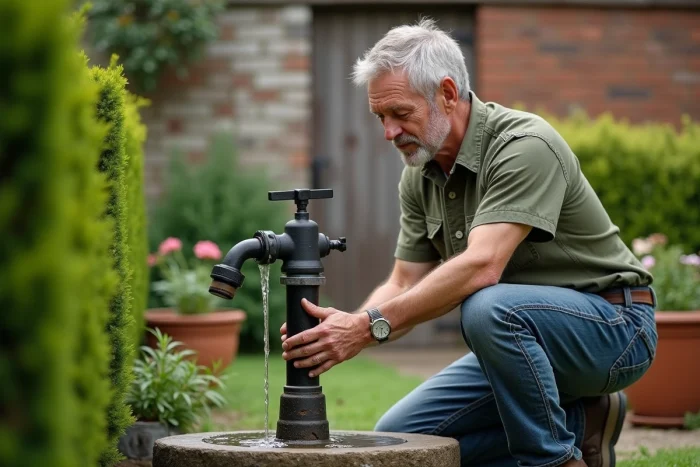
Choosing a water pump for your garden involves sizing a technical link that affects the irrigation flow rate, the pressure at the sprinklers, and the energy bill throughout the season. Two parameters separate a relevant purchase from an underutilized investment: the total dynamic head and the actual flow rate at the circuit’s output. The rest, such as pump type, motor power, and water source, directly follows from this.
Surface pump, submersible pump, or booster pump: comparison table by garden use
Competitors list pump types without always cross-referencing the data. The table below compares the parameters that matter for garden use: suction depth, compatibility with an automatic irrigation system, and the ability to handle frequent starts.
| Type of pump | Max suction depth | Typical pressure | Compatible with automatic irrigation | Suitable water source |
|---|---|---|---|---|
| Surface pump | 7-8 m | Medium to good | Yes, with external timer | Rainwater tank, river, shallow well |
| Submersible pump | Beyond 8 m | High | Yes | Deep well, declared borehole |
| Booster pump (pressure group) | 7-8 m | Regulated and constant | Yes, ideal for drip irrigation and sprinklers | Tank, low-pressure network |
The booster pump stands out for its ability to maintain a stable pressure even when the flow varies, making it particularly suitable for circuits combining rotating sprinklers and drip irrigation. A classic surface pump, on the other hand, sees its pressure drop as soon as multiple points are opened simultaneously.
Finding gardening tips on Jardino allows you to refine this initial selection based on the configuration of your land and your water source.
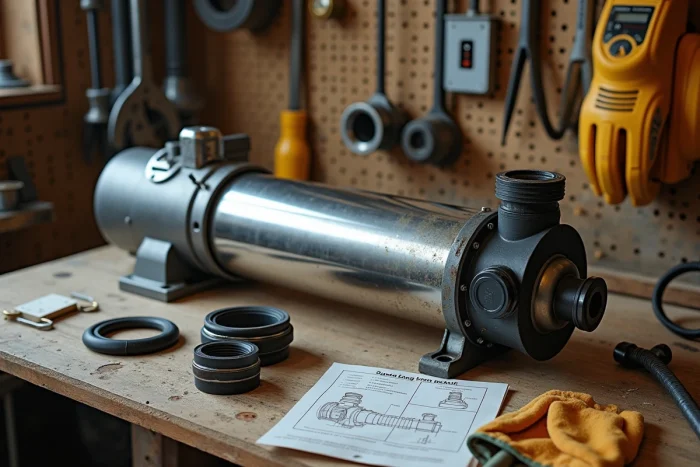
Total dynamic head and flow rate: the two values that determine sizing
The total dynamic head (TDH) adds the vertical distance between the pump and the highest point of use, the pressure losses in the pipes, and the pressure required at the sprinkler outlet. Underestimating this parameter is the most common mistake: a powerful pump on paper can deliver a trickle of water if the circuit imposes too much resistance.
Pressure losses and pipe length
The longer and narrower the pipe network, the greater the pressure losses. A small diameter pipe over a distance of several dozen meters can absorb a significant part of the available pressure. Increasing the pipe diameter reduces pressure losses much more effectively than increasing motor power.
Required flow rate according to the irrigation system
The flow rate is calculated by adding the consumption of each irrigation point operating simultaneously. A drip irrigation network requires little flow but consistent pressure. A set of rotating sprinklers demands a significantly higher flow rate.
- A drip irrigation circuit typically operates at low pressure and low flow, which suits a modest surface pump or a compact booster pump.
- Retractable sprinklers require higher pressure and flow, steering the choice towards a booster pump or a high-capacity surface pump.
- A mixed system (sprinklers + drip irrigation) requires a booster pump with a buffer tank to absorb demand variations between zones.
Water pump and connected irrigation: a selection criterion that guides overlook
Irrigation systems increasingly incorporate timers, solenoid valves, and sensors (rain gauge, soil moisture probe). This automation has a direct impact on pump selection: it must withstand frequent start and stop cycles without overheating or premature motor wear.
A basic surface pump, without a pressure switch or tank, starts up every time a solenoid valve opens and stops when it closes. On an irrigation program divided into several zones, this can represent a dozen starts per session. Booster pumps equipped with a membrane tank (or expansion vessel) absorb these shocks: the pump only restarts when the pressure in the tank drops below a defined threshold.
For home automation or connected control, check the pump’s compatibility with an external controller. Some models integrate an electronic box capable of communicating with a centralized timer, avoiding the need for an intermediate relay.
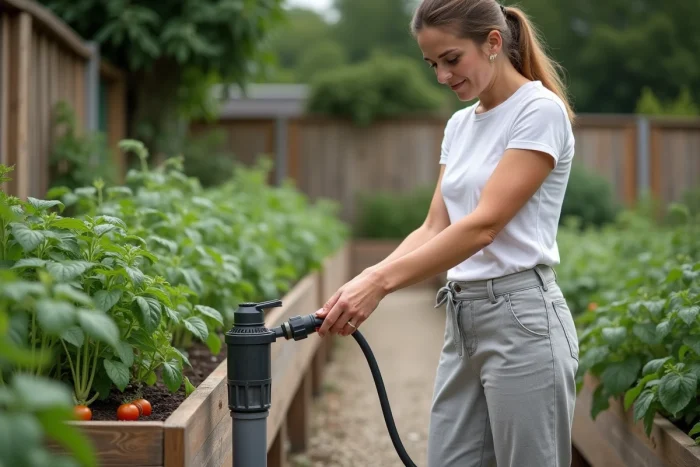
Irrigation restrictions and alternative sources: adapting the pump to regulatory context
Drought orders are multiplying and temporarily limit the use of drinking water for irrigation. Pumping from a rainwater harvesting tank or a declared well becomes both a practical and regulatory choice. This change in source alters the sizing.
Rainwater stored in an above-ground tank is at a shallow depth: a surface pump or booster pump is sufficient. Water from a well several meters deep points towards a submersible pump. In both cases, water quality matters: water laden with particles (sand, organic matter) requires a pre-filter or a pump designed for unclear waters, or else the turbines may be damaged.
- Above-ground or shallow buried tank: surface pump with suction strainer and check valve.
- Well between 8 and 20 m: submersible pump sized for the diameter of the casing.
- Deep borehole: submersible borehole pump, installation by a professional recommended to ensure compliance with the declaration at the town hall.
Precise flow rate adjustment, enabled by a booster pump or frequency converter, helps meet locally imposed consumption thresholds while maintaining effective irrigation.
Choosing a water pump for the garden boils down to three sequential decisions: identifying the source (tank, well, borehole), calculating the total dynamic head of the circuit, and then checking that the flow rate meets the simultaneous demand of all sprinklers and drippers. A booster pump with a buffer tank remains the most versatile choice for a garden equipped with an automatic irrigation system, whether programmed or connected.