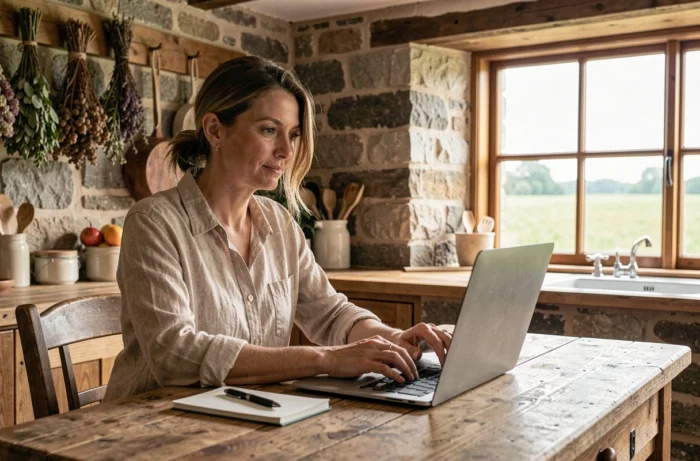
Finding the right contact at a local farm is no longer just about picking up a landline phone between noon and two. French farms are diversifying their contact channels, using web forms, instant messaging, and shared platforms. This increase in entry points simplifies certain processes, but it also muddles clarity for consumers who just want to ask a question or place an order.
Contact form on a farm’s website: what really happens on the producer’s side
Most farms with a showcase website offer a contact form. The tool seems ordinary, but its functionality varies significantly from one farm to another.
In smaller operations, the form often redirects to a personal email address checked irregularly. The producer is out in the fields, making deliveries, or processing products. The response time often exceeds two business days without indicating a lack of seriousness.
More structured direct sales operations sometimes incorporate a messaging system with automatic acknowledgment of receipt. This is the case when you can contact La Fermette De Marie via the website, where the form directs the request according to its nature (order, information, visit). This type of organization remains a minority among French farms, but it facilitates the sorting of incoming requests.
One often overlooked point: the contact form does not guarantee product availability. Sending a message to reserve a meat package or a batch of vegetables does not equate to order confirmation. Without an integrated online payment system, the reservation remains informal.
Click-and-collect and farm drives: contact channels that initiate a transaction
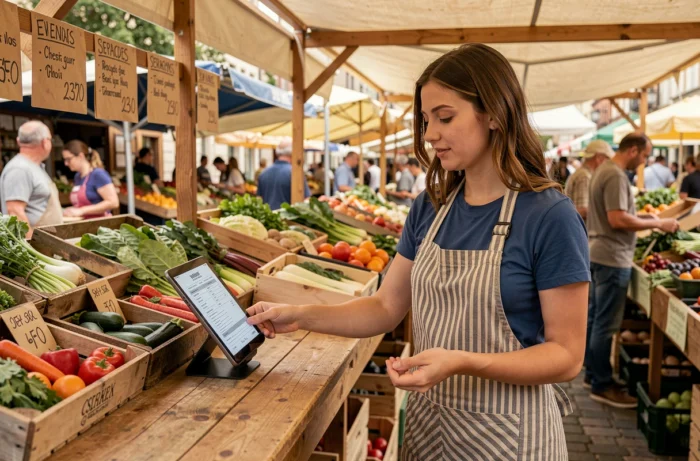
Click-and-collect transforms contact into a purchasing act. The customer orders online, pays, and then picks up their products during a time slot defined by the producer. This organization avoids fruitless trips when stocks are depleted.
Farm drives operate on a different principle than individual sites. They bring together several producers on a shared platform, with online payment and centralized pickup. The consumer therefore contacts a collective rather than an isolated farm.
This distinction has practical consequences:
- On an individual farm site, the question posed via the form concerns a single producer, who manages their own stocks and responses.
- On a farm drive, the platform acts as an intermediary: the message may be filtered, redirected, or processed by a coordinator before reaching the relevant producer.
- The response time and quality therefore depend on the service architecture, not just the availability of the farmer.
For the consumer, the difference comes at the time of ordering. Click-and-collect confirms availability in real time, whereas a simple email exchange leaves some uncertainty about remaining stock.
Social networks and messaging: a quick channel but without traceability
Many local farms use Facebook or Instagram as their main showcase, sometimes even before having a website. Private messaging then becomes the first reflex to reach the producer.
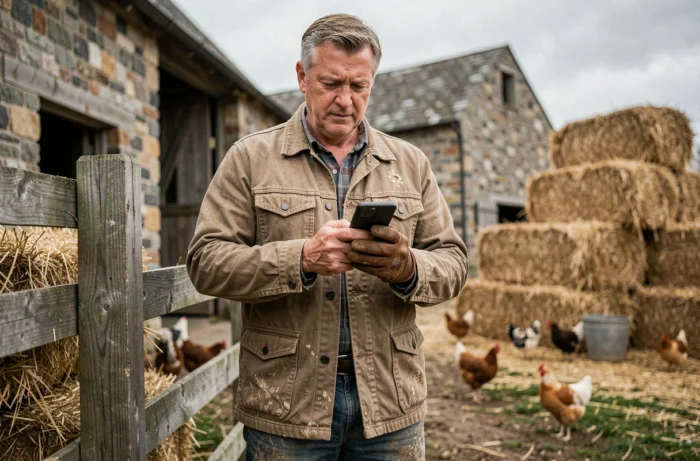
Responsiveness is often better than with a traditional form, as notifications arrive on the operator’s personal phone. However, these exchanges leave no trace that can be used in case of a dispute. No order number, no formal confirmation, no proof of payment if the payment is made in cash upon pickup.
Requests made via social messaging escape any obligation for commercial follow-up. A farm has no legal obligation to respond to an Instagram message within a given timeframe, nor to keep a history of exchanges. For a simple request (hours, product availability), the channel works. For an order involving a significant amount, it is better to opt for a support that generates a receipt.
Health obligations and limits of online-only for direct sales
Contacting a farm online to order food products of animal origin does not exempt the producer from their regulatory obligations. The declaration of handling goods and hygiene package rules apply to direct sales, whether the order is placed via a web form, by phone, or in person.
This regulatory framework explains why some farms voluntarily limit their online offerings. Offering meat or dairy products in click-and-collect requires documented cold chain management up to the pickup point. A farm that lacks the necessary infrastructure would prefer to direct the customer to a pickup at the farm, with visual control at the time of handover.
Field reports vary on this point: some operations believe that online sales simplify traceability (timestamping of the order, lot identification), while others consider the administrative burden disproportionate relative to the volume sold.
What the consumer can check before ordering
- The presence of a SIRET number or legal mention on the farm’s website, which attests to a declared activity.
- The existence of a secure payment system, even basic, rather than a simple transfer to a personal bank account.
- The explicit mention of withdrawal and product preservation conditions on the order page or in the confirmation email.
The absence of these elements does not mean fraud, but it indicates a level of commercial structuring that may complicate follow-up in case of a problem. Shared platforms like farm drives generally integrate these guarantees by default, which is a concrete advantage for occasional buyers.
Online contact with a local farm is becoming smoother each year, driven by click-and-collect and collective platforms. The trade-off remains a marked heterogeneity between operations: from a handcrafted form checked twice a week to an ordering system with integrated payment, the experience varies greatly depending on the size and organization of the producer.