
A sinking or cracked threshold does not only pose an aesthetic problem. The misalignment alters the mechanics of the door leaf, accelerates the wear of the rollers or pivots, and can distort the adjustment of a motorization. Renovating this threshold requires a structural diagnosis before any implementation, or else the project may need to be redone a few months later.
Structural Repair Mortars and Motorization Compatibility
We still observe too many construction sites where a simple bastard mortar is poured over a degraded threshold, without taking into account the mechanical constraints specific to a motorized gate. The vibrations transmitted by the motor, combined with the pulling forces on the fixing plates, require a mortar whose tensile and adhesion strength far exceeds that of a conventional leveling compound.
In recent years, manufacturers such as Mapei (Planitop HPC Floor range) or Saint-Gobain Weber (Weber niv dur) have offered structural repair mortars formulated to withstand these stresses. Their elasticity modulus remains compatible with old concrete, which limits the risk of differential detachment.
Before applying one of these products, it is possible to level a gate threshold with Cileo Habitat by following a support preparation protocol adapted to the type of degradation encountered.
The preparation of the support determines the adhesion of the mortar. A threshold that is simply dusted off is not enough. We recommend mechanical brushing with a diamond disc to open the pores of the concrete, followed by a bonding primer applied in a cross layer. Adhering to the primer’s drying time (often underestimated) ensures that the resin remains sticky at the time of pouring.
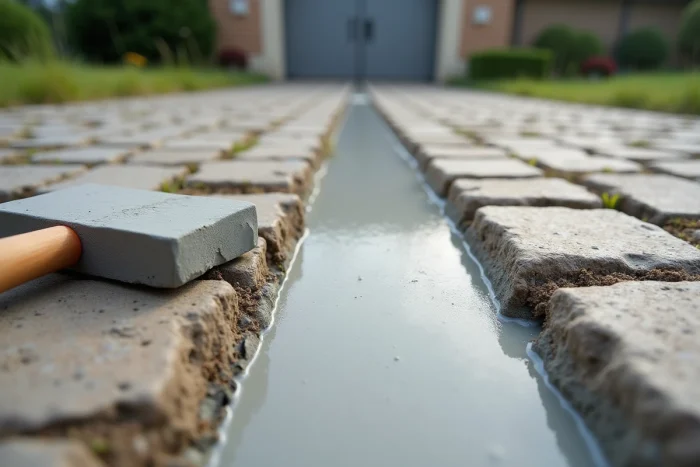
Formwork and Reinforcement of a Concrete Gate Threshold
When the level defect exceeds a few centimeters or the original concrete shows deep spalling, leveling is no longer sufficient. A section must be rebuilt by formwork and new pouring.
Formwork Sizing
The formwork must accommodate the total width of the threshold plus the additional thickness of the repair. We use formwork boards secured with clamps and masonry props, checking the horizontal alignment with a laser level. Poorly adjusted formwork produces a bulging threshold that will block the rail of a sliding gate or create a friction point on a swinging gate.
The bottom of the formwork receives a release agent layer (vegetable oil or dedicated product) to facilitate demolding without chipping the fresh surface.
Reinforcement and Connection with the Existing Threshold
The junction between the old concrete and the new concrete is the weak point of the project. We drill holes with an SDS drill in the existing threshold to set in connection bars (small diameter twisted bars). These steels ensure load transfer and prevent the new section from sliding under the repeated passage of vehicles.
The welded mesh placed at mid-thickness of the new slab absorbs bending forces. Without it, the unreinforced concrete will crack sharply in the first winter if the ground freezes deeply.
- Drill the old concrete every twenty centimeters or so to secure the connection bars with chemical anchoring mortar
- Position the welded mesh on plastic spacers to ensure minimal coverage of the steels
- Pour the concrete in a single pass, vibrating with a needle or vibrating trowel to eliminate trapped air bubbles under the reinforcement
Slope Management and Water Drainage at the Threshold
A perfectly horizontal gate threshold is a mistake. Standing water seeps into microcracks, freezes, and causes the surface concrete to spall (freeze-thaw phenomenon). We systematically set a drainage slope directed towards the outside of the property or towards an existing drain.
The adjustment of this slope is done at the time of formwork, by raising the inner board slightly higher than the street-side board. A bubble level placed on a masonry rule allows for checking the consistency of the slope along the entire length of the threshold.
On clayey soils, the slope alone is not enough. Adding an agricultural drain at the foot of the threshold, connected to the stormwater system, prevents water from stagnating under the foundation and causing differential settling. This execution detail is rarely mentioned in consumer guides, even though it conditions the lifespan of the threshold on clay soil.

Accessibility and Step at the Gate
Renovating a threshold is an opportunity to bring the pathway into compliance with accessibility recommendations. The inter-ministerial accessibility guide for individual houses, updated in 2022 by the Ministry of Ecological Transition, specifies the need to limit steps at the gates when they constitute a usual pathway.
In practical terms, this means that a raised threshold should not create a sharp step. The technical solution involves a chamfer or a gentle slope connection on either side of the threshold, rather than a sharp angle. This detail also benefits stroller wheels, carts, and vehicle tires, which experience less jolt with each passage.
We incorporate this constraint from the formwork phase by extending the side cheeks to form a transition bevel. The additional cost is negligible, but the difference in user comfort and regulatory compliance is significant.
Drying, Protection, and Durability of the Renovated Threshold
Freshly poured concrete reaches its nominal strength after several days of curing. During this period, the threshold must remain moist (polyethylene tarp or regular watering) to avoid shrinkage that would cause surface cracking.
No vehicle should drive over the threshold before the end of the complete curing period. The temptation to reopen the passage too soon is the primary cause of premature cracking that we observe on renovation sites.
Once the concrete has hardened, applying a surface water repellent (such as silane-siloxane) reduces capillary absorption and protects the steels from corrosion. This treatment is renewed every few years depending on the threshold’s exposure to the elements and de-icing salt.
A properly reinforced, drained, and protected gate threshold withstands the daily passage of vehicles for many years without issue. Any partial repairs, if they become necessary, are limited to cosmetic leveling rather than a complete reconstruction.