
Family life is not just a sum of shared moments. Recent research on work-life balance points to an often underestimated factor: the temporal flexibility of parents influences the quality of family relationships more than the sheer number of hours spent at home.
This finding, highlighted by DARES in its survey on working conditions, reshapes how we can think about family daily life.
Parental Schedule Flexibility and Family Climate
DARES has shown that employees with flexible hours report fewer work-family conflicts and greater overall satisfaction, regardless of actual working hours. In other words, a parent who comes home late but has control over their schedule will experience less domestic friction than a parent who is present but constrained by rigid hours.
This data changes the perspective. Instead of feeling guilty about the number of meals shared each week, the priority shifts to the ability to reschedule a time slot, take a half-day when a child needs it, or occasionally work from home. Resources like lapetiteemma.fr address these adjustments in parental daily life with a pragmatic approach.
However, this flexibility is unevenly distributed. Field jobs, the healthcare sector, or the restaurant industry rarely offer this latitude. For these families, the issue is not about reorganizing their schedules but maximizing the quality of the available moments, no matter how brief.
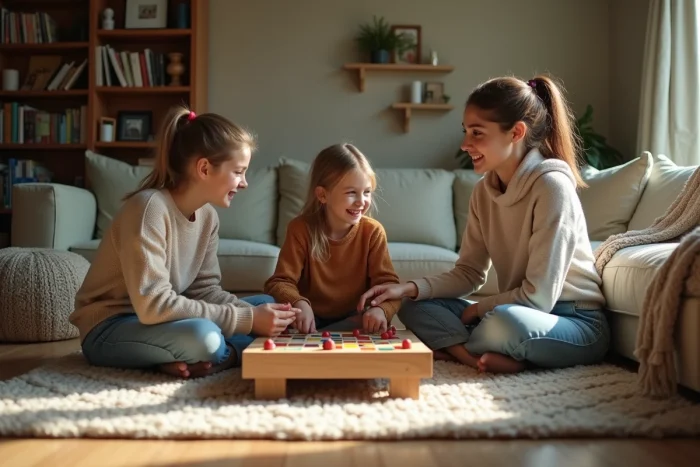
Shared Screens in Family: A Cohesion Lever Under Conditions
The idea that screens systematically harm family life deserves nuance. A systematic review published in Child Development Perspectives in 2023 (Madigan et al.) distinguishes two very different uses: passive individual screen time and what researchers call co-mediation.
Co-mediation involves watching a movie together while commenting, playing a cooperative video game, or exploring an educational video together. In these configurations, the screen becomes a medium for interaction, not a substitute. Families that regularly engage in these activities report a strengthened sense of connection.
What Distinguishes a Screen Imposed from a Shared Screen
- A shared screen implies a collective decision: we choose together what to watch or what to play, which already involves family negotiation
- Interaction during the activity matters as much as the activity itself: commenting, laughing, debating a character creates bonds where silence in front of an individual screen isolates
- Duration remains a parameter: a family movie night once a week does not have the same effect as four hours of content consumed side by side without exchange
The available data do not allow for a conclusion on a precise hourly threshold beyond which shared screen time would lose its benefits. Field feedback varies on this point depending on the children’s age and the type of content.
Post-Covid Parental Stress and Emotional Availability
Public health data post-Covid are unequivocal on one point: one in two parents in Europe reports a persistent increase in stress or anxiety. WHO Europe has recommended since 2022 to integrate care practices specifically aimed at parents, not just children.
The link between parental stress and the quality of family life is direct. An anxious parent shouts more, punishes more, and is less emotionally available. This is not a matter of will or theoretical kindness; it is a matter of nerve load.
Caring for the Parent to Care for the Family
WHO Europe’s recommendation is not aimed at adding an additional obligation (doing yoga, meditating, keeping a journal). It rather points to the necessity of structural support: easier access to psychological support, parent support groups, and concrete relief of mental load from family or institutions.
Expecting an exhausted parent to independently apply emotional management techniques amounts to treating a symptom without addressing the cause. Families that function well are not those where parents never get angry. They are those where the parent has resources to recover after a difficult period.

Family Rituals: What Regularity Changes Practically
The evening meal taken together appears in most recommendations on family life. But reducing rituals to this single moment would be reductive. An effective family ritual is predictable, short, and non-negotiable.
Here are some examples that work beyond shared dinner:
- A daily five-minute roundtable where each family member shares a positive event and a difficult event from their day, without judgment or immediate advice
- A fixed weekly outing, even brief (walk, market, library), where regularity matters more than duration or spectacle
- A dedicated time on weekends where each child has an individual slot with a parent, without siblings, to discuss whatever they wish
The predictability of these moments creates a secure framework. The child knows they will have their space to speak, which reduces attention-seeking behaviors at other times.
These rituals require neither budget nor complex organization. Their difficulty lies in consistency. Maintaining a family ritual over several months has a greater effect than a week of exceptional vacation. Repetition builds trust, and trust builds relationships.
A thriving family life does not rely on a single model. It depends on each household’s ability to identify its own levers: schedule flexibility when possible, screens transformed into moments of exchange, attention to parents’ mental health, and simple rituals maintained over time. None of these avenues work in isolation, but their combination, tailored to each family configuration, sustainably alters daily life.