
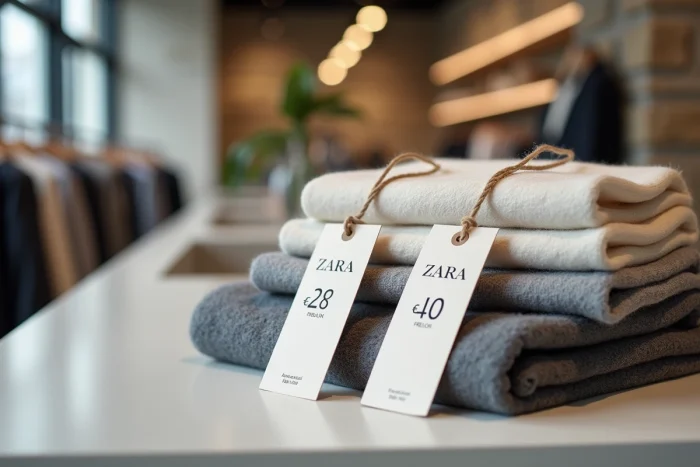
The same Zara t-shirt can cost significantly less in Madrid or Lisbon than in Paris or Brussels. The gap is not limited to a few cents: according to Eurostat data from 2022, the price of clothing and shoes in the Iberian Peninsula was 12% lower than the European Union average. This discrepancy affects all brands of the Inditex group, from Pull&Bear to Massimo Dutti.
It is Zara that consumers scrutinize the most for these differences.
Localized pricing strategy at Inditex: a commercial choice, not an accident
Inditex does not practice a single pricing strategy across Europe. The group applies a pricing policy tailored to each market, which it refers to in its investor communications as “localization.” Specifically, the price of an item is set country by country, based on several local parameters.
This approach explains why a coat sold in France or Germany has a higher price than one offered in Spain or Portugal. Inditex’s headquarters, located in Arteijo, Galicia, calibrates its pricing grids to remain competitive against local competition and the purchasing power of each area.
The difference is therefore not merely a result of logistical costs. It reflects a deliberate margin trade-off: Inditex accepts tighter margins in its domestic market, where Zara’s brand recognition is historic and where competitive pressure from local brands remains strong. To delve deeper into this topic, a detailed analysis of Zara prices in Spain and Portugal allows for measuring the concrete disparities between countries.

VAT, purchasing power, and taxation: the structural factors behind Zara prices
The VAT rate on clothing varies from one European country to another, and this gap is directly reflected in the prices displayed in stores. Spain and Portugal apply consumption tax levels that differ from those practiced in France or northern European countries.
Local purchasing power also weighs into the equation. Fashion brands adjust their prices to remain accessible to their target clientele. In a market where the median income is lower, displaying the same prices as in Scandinavia or Switzerland would exclude a portion of buyers.
The variables that impact the final price
- The applicable VAT rate on clothing, which differs from country to country within the European Union and modifies the final price without affecting the retailer’s margin.
- The median income of the country, which forces brands to adapt their pricing strategy to maintain sufficient sales volume.
- Local competition: in Spain, Zara faces domestic brands with very low prices (Lefties, a brand of the same group, or independent stores), which drives prices down.
- Real estate and personnel costs in stores, generally lower in the Iberian Peninsula than in France or Germany.
Logistical proximity: a real but not decisive advantage
The argument often comes up: Zara produces part of its collections in Portugal, Spain, and Turkey, which would reduce transportation costs to Iberian stores. The reasoning holds partially. The proximity of the main logistics center, located in Galicia, indeed shortens distribution circuits for Spanish and Portuguese stores.
However, logistics represent only a fraction of the final price of a garment. Recent economic analyses on price formation in fashion show that the share of transportation in the total cost remains modest compared to design, materials, labor, and commercial rents. Attributing the bulk of the price gap to the geographical proximity of factories would therefore be reductive.
The real lever is the combination of all these factors. Inditex optimizes its margins market by market, absorbing certain costs rather than uniformly passing them on. The result: a price displayed in Spain that reflects both a commercial strategy and a logistical reality.
Local competition and price pressure in the Iberian Peninsula
Spain hosts a high number of accessible fashion brands, all stemming from the same industrial ecosystem. Zara, Pull&Bear, Bershka, Stradivarius, Oysho, Massimo Dutti: these brands belong to the Inditex group, founded by Amancio Ortega in La Coruña in 1963. This is complemented by direct competitors like Mango, based in Barcelona, or international chains (H&M, Primark) that are well established locally.
This competitive density creates a constant pressure on retail prices. To retain its Spanish and Portuguese customer base, Zara has no choice but to remain competitive against brands targeting the same segment. Conversely, in countries where fast-fashion competition is less concentrated, Inditex has more latitude to position its prices slightly higher.
The Lefties case: Inditex competes with itself
The group recently opened Lefties stores in France, its most accessible brand. This chain, already very present in Spain, sells clothing at prices significantly lower than those of Zara. Its arrival in the French market illustrates Inditex’s desire to occupy all price segments, including against Shein and Primark.
The very existence of Lefties in the Inditex portfolio confirms that the group segments its brands by price level and market. Zara remains the flagship, with a mid-range positioning that varies by country.
Price differences between European countries for the same brand are not an anomaly. They result from a combination of commercial decisions, tax constraints, and competitive realities specific to each territory. For a French consumer, the reflex to order from Spain or to take advantage of a trip to fill their suitcase remains rational, as long as the differences in VAT and shipping costs do not erode the savings made.